
Mystic Realms: Golden Triangle & Bhutan Escape
Ratings of India Travel Factory
Trip Overview
Highlights
Reviews
Places Visited
Places Visited:Delhi, Agra, Jaipur, Paro, Thimpu, Punakha, Paro
Duration
13 nights & 14 days
Tour categories
Standard, Deluxe and Luxury

Customizable Itinerary
This is a sample itinerary to inspire a personalized trip designed with your travel specialist
Discover India’s Golden Triangle & The Mystical Kingdom of Bhutan: A 14-Day Journey – Embark on an extraordinary 14-day adventure blending the iconic wonders of India’s Golden Triangle with the serene spirituality of Bhutan, the Land of the Thunder Dragon. Your journey begins in Delhi, exploring its historic Old City and modern New Delhi. Witness the timeless beauty of the Taj Mahal at sunrise in Agra and delve into the royal heritage of Jaipur’s Pink City, including the magnificent Amber Fort.
Transition to the Himalayas with a breathtaking flight to Paro, Bhutan. Immerse yourself in Thimphu’s unique culture, from its colossal Buddha Dordenma to its vibrant markets and ancient dzongs. Traverse the scenic Dochu-la Pass with its 108 stupas and explore the majestic Punakha Dzong. Experience authentic village life and spiritual encounters with monks. The adventure culminates in Paro with an unforgettable excursion to the iconic Tiger’s Nest Monastery, perched dramatically on a cliff. This meticulously curated tour promises an unparalleled cultural and spiritual immersion across two captivating nations.
Customizable Itinerary
+ Day 1: Arrive in Delhi, India – Gateway to the Subcontinent
Welcome to Delhi, India's dynamic capital city! After clearing immigration and baggage formalities at Indira Gandhi International Airport (DEL), our friendly representative will greet you in the arrival hall, holding a placard with your name for easy recognition. You'll be escorted to your private vehicle and transferred directly to your hotel for check-in. Prepare for an incredible adventure ahead!
+ Day 2: Explore Old & New Delhi – A Tale of Two Cities
Dive into Delhi's captivating history and vibrant present. Begin your morning exploring Old Delhi, starting with a visit to the magnificent Jama Masjid, one of India's largest mosques. Experience the bustling energy of Chandni Chowk with an exhilarating rickshaw ride through its narrow, historic lanes. You'll also drive past the formidable Old Fort, echoing tales of bygone eras.
The afternoon transitions to the grandeur of New Delhi. Your sightseeing tour includes the iconic Qutub Minar, a UNESCO World Heritage Site and India's tallest brick minaret, standing at an impressive 72.5 meters. Next, discover the architectural beauty of Humayun’s Tomb, a precursor to the Taj Mahal. Your drive through New Delhi will showcase significant landmarks like Connaught Place, the symbolic India Gate, and the majestic Rashtrapati Bhavan (President’s House).
+ Day 3: Travel to Agra – City of the Taj Mahal
Today, you'll journey approximately 4 hours by road to Agra, the legendary city of the Taj Mahal.
In the afternoon, embark on a captivating sightseeing tour of Agra. Your first stop is Agra Fort, another UNESCO World Heritage site. This impressive red sandstone fortress, more accurately described as a walled city, was a stronghold of the Mughal Empire. Learn about its rich history, including the capture of the famous Koh-i-Noor diamond within its walls. Later, enjoy a visit to Mehtab Bagh, a serene garden complex across the Yamuna River, offering the most picturesque views of the Taj Mahal for stunning photographs, especially as the afternoon light softens.
+ Day 4: Agra to Jaipur via Fatehpur Sikri – The Pink City Beckons
Rise early for a magical sunrise visit to the Taj Mahal. No words, books, or stories can truly capture the ethereal beauty of this UNESCO World Heritage Site and symbol of eternal love. Witnessing its marble façade glow with the first rays of sun is an experience that will undoubtedly captivate your heart.
After this unforgettable experience, return to your hotel for breakfast and check-out. Post-breakfast, begin your scenic 5-hour drive to Jaipur, Rajasthan's enchanting "Pink City." En route, you'll stop to explore Fatehpur Sikri, a fascinating historical site. Originally built by the Sikriwal Rajput Rajas, it was later famously captured by Emperor Akbar, who renamed it Fatehpur (City of Victory) Sikri.
Upon arrival in Jaipur, check into your hotel and relax after your journey. In the evening, feel free to stroll through the vibrant old bazaars of this charming Pink City.
+ Day 5: Explore The Pink City, Jaipur – Royal Forts & Palaces
Begin your day with an iconic experience at Amber Fort. En route, pause to admire the stunning facade of Hawa Mahal (Palace of Winds). At Amber Fort's entrance, you'll have the unique option to ascend to the fort like royalty, enjoying an unforgettable elephant ride up the ramparts (return by foot). Explore the sprawling courtyards and intricate palaces within.
After your Amber Fort visit, proceed to the City Palace, a majestic complex comprising the Chandra Mahal and Mubarak Mahal palaces. This grand residence of the Maharaja of Jaipur showcases a blend of Rajput and Mughal architecture. While a significant part remains a royal residence, the Chandra Mahal now houses a fascinating museum.
You'll also visit the ancient astronomical instruments at Jantar Mantar Observatory and the beautiful Birla Temple. If time permits, immerse yourself further in Jaipur's charm by exploring its famous local bazaars, where every shop is painted in the city's signature pink hue.
+ Day 6: Travel Back to Delhi – Leisure & Last-Minute Souvenirs
After breakfast, enjoy a comfortable drive back to Delhi. Upon arrival, the rest of your evening is at leisure. You might choose to relax at your hotel or seize the opportunity for some last-minute souvenir shopping in Delhi's diverse markets.
+ Day 7: Delhi, India to Paro, Bhutan & Transfer to Thimphu – Himalayan Kingdom Beckons
Today marks an exciting transition as you're transferred to Delhi Airport to catch your flight to Paro, Bhutan. The flight to Paro is renowned as one of the most spectacular in the entire Himalayas, offering fascinating views as you fly along the mountain range or over the foothills. The descent into the Kingdom is truly exciting!
Bhutan's first welcome is the cool, clean, and fresh mountain air as you disembark. After efficient immigration formalities and baggage collection, our Bhutanese representative will warmly greet you. You'll then enjoy a scenic drive to Thimphu, the capital town. En route, make a brief stop at Chuzom, the confluence of the Thimphu and Paro rivers, distinctively adorned with Tibetan, Nepalese, and Bhutanese style stupas.
Thimphu, a unique city that blends modern development with ancient traditions, serves as Bhutan's center of government, religion, and commerce. Despite being a capital, it maintains a strong national character through its remarkable architectural style. Upon arrival, check into your hotel.
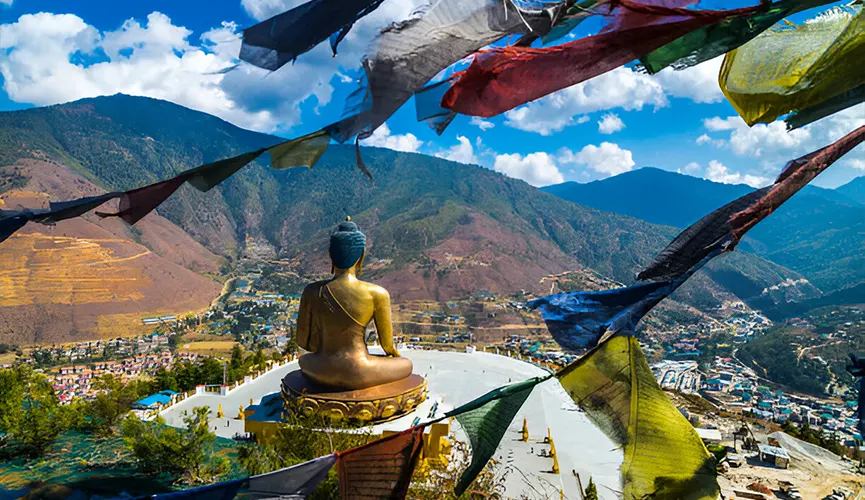
Later, drive to Buddha Point (Kuensel Phodrang). From this vantage point, you'll get an excellent overview of the Thimphu Valley. Pay your respects and offer prayers to the Buddha, represented by the largest statue in Bhutan, before taking in the serene valley views. Conclude your day with an exploratory walk around Thimphu's main street and bustling market area.
+ Day 8: Thimphu – Cultural Depths & Monastic Life
After breakfast, embark on a short drive (15 km) to Pangri Zampa, a significant 16th-century monastery located just north of Thimphu. Here, you'll observe Buddhist student monks learning Lamaism and astrology, and have the opportunity to interact with them, gaining insights into their spiritual education.
Next, enjoy a guided tour of Thimphu's main cultural highlights:
Textile Museum: Experience the living national art of weaving, with exhibitions showcasing major weaving techniques and styles of traditional Bhutanese dress and textiles.
National Library: Discover the rich history of Bhutan preserved in archaic texts, ancient manuscripts, and a collection of modern academic books and prayer flag printing blocks.
Institute for Zorig Chusum (Arts & Crafts School): Commonly known as the Painting School, this institute offers a six-year course on Bhutan's 13 traditional arts and crafts. See students mastering various skills taught at the school.
Folk Heritage Museum: This museum is dedicated to connecting visitors with Bhutan's rich folk heritage and rural history through engaging exhibits, demonstrations, and documentation of traditional life.
After lunch, continue your city tour:
Memorial Chorten: Visit this revered stupa built in memory of Bhutan’s third King, His Late Majesty, King Jigme Dorji Wangchuk, considered the Father of modern Bhutan. The paintings and statues inside offer a deep insight into Buddhist philosophy.
Changangkha Lhakhang: Perched on a ridge above Thimphu, this fortress-like temple and monastic school was established in the 12th century. It offers a fascinating view of the Thimphu valley, with its central statue being Chenrezig with 11 heads.
Trashichhoe Dzong: Conclude your day with a visit to the "fortress of the glorious religion." This is the center of government and religion, home to the monarch’s throne room and the seat of the Je Khenpo (Chief Abbot). Built in 1641 and reconstructed in the 1960s in traditional Bhutanese manner without nails, it's a testament to Bhutanese craftsmanship.
+ Day 9: Thimphu to Punakha & Wangdue – Over Dochula to Fertile Valleys
After breakfast, drive up to Dochu-la Pass (3,088m / 10,130 ft). Stop here briefly to take in the breathtaking views and admire the 108 Druk Wangyal Chortens, built by the eldest Queen Mother. On clear days, you'll see a spectacular panorama of Himalayan peaks, including the formidable Gangkar Puensum, Bhutan's highest. Explore a part of the Royal Botanical Park, Bhutan's first botanical park, which forms the beautiful backdrop of the Dochula Pass.
Later, continue your drive to Punakha. Punakha served as Bhutan's capital until 1955 and remains the winter seat of the Je Khenpo (Chief Abbot). Blessed with a temperate climate and fed by the Pho Chhu (male) and Mo Chhu (female) rivers, the fertile Punakha valley yields abundant crops and fruits, making it a popular year-round destination at 1300m above sea level.
After lunch, visit the magnificent Punakha Dzong (Palace of Great Happiness), built in 1637 at the junction of the Phochhu and Mochhu rivers. This majestic dzong served as both the religious and administrative center of Bhutan. Explore its courtyards and religious statuary, gaining a deeper understanding of this intricate and long-established culture.
Then, enjoy a short excursion to Chimi Lhakhang, situated on a hillock in the center of the valley. Known as the Temple of Fertility, it's widely believed that couples praying here are soon blessed with a child. The trail leads across picturesque rice fields to the tiny settlement of Pana, offering rare glimpses into the daily life of villagers. In the evening, explore the newly developed Wangdue town and its local market.
+ Day 10: Punakha & Wangdue – Rural Tranquility & Spiritual Encounters
After breakfast, your day focuses on the cultural richness surrounding Punakha. You'll have another opportunity to visit the majestic Punakha Dzong and the serene Chimi Lhakhang, allowing for deeper appreciation or a more leisurely visit.
Post-lunch, embark on an excursion to Talo Village. Scattered along the hill slopes, Talo is renowned for its cleanliness and hygiene among Punakha villages. It's also the seat of the mind incarnations of the Zhabdrung. Talo Sangnacholing Dzong, built on a plateau, offers majestic views of surrounding villages. Observe the beautiful farmhouses with their own flower gardens and the abundance of corn and sweet peas grown on the hill slopes. Spend time in Nobgang and Talo villages, visiting farmhouses and meeting families to experience authentic Bhutanese rural life.
Also, visit the Nalanda Buddhist Institute (known locally as ‘Dalayna’ or Nalanda Buddhist College). This monastic school near Talo village, above the Punatsangchu River, offers a unique opportunity to interact with monks, gaining knowledge on Buddhism and meditation practices.
+ Day 11: Punakha & Wangdue to Paro – Return to the Valley of Beauty
After breakfast, enjoy a scenic drive to Paro along the beautiful highway. En route, visit Simtokha Dzong, the country's oldest fortress built in 1627, which now houses the School for Buddhist Studies. Upon arrival in Paro, check into your hotel.
The beautiful Paro Valley is a cultural gem, brimming with scenic beauty, myths, and legends. It hosts many of Bhutan’s oldest temples and monasteries, the National Museum, and the country's only international airport. Mount Chomolhari (7,314m) stands in white glory at the northern end, its glacial waters forming the Pa Chhu (Paro River). Paro is also one of the most fertile valleys, famously producing the local red rice from its terraced fields.
Post-lunch, visit Ta Dzong, originally a watchtower, now home to the National Museum. Its extensive collection includes antique thangkha paintings, textiles, weapons, armor, household objects, and a rich assortment of natural and historic artifacts. Immediately following, enjoy a short walk down to Rinpung Dzong (Paro Dzong), meaning “fortress of the heap of jewels.” This dzong boasts a long and fascinating history, with fine wall paintings illustrating Buddhist lore in its inner courtyards. In the evening, explore the Paro town center and market area.
+ Day 12: Paro – Full-Day Excursion to Haa Valley & Chelela Pass
After breakfast, embark on a full-day excursion to the serene Haa Valley via Chelela Pass. At 3,988 meters (13,084 ft), Chelela is considered one of Bhutan’s highest motorable passes. The approximately hour-long drive through thickly forested roads is a botanical paradise, offering stunning views of the sacred mountains Jumolhari and Jichu Drake, marked by hundreds of prayer flags fluttering in the wind.
The Haa Valley lies on Bhutan's westernmost edge, bordering Tibet's Chumbi Valley and dividing it from Sikkim. Opened to tourism in 2002, Haa is one of Bhutan's least populated districts, with much of its landmass covered by dense forest and fertile fields.
Explore the exotic Haa Valley and visit Lhakhang Karpo (White Temple), established in the 7th century by Tibetan King Songtsen Gempo. Legend says a white pigeon chose this site at the foothills of the 'Rigsum Gonpo' mountains. Then, visit Lhakhang Nagpo (Black Temple), also built in the 7th century, situated north of Lhakhang Karpo. Both temples serve as guardian sentinels at the south entrance of Haa Valley. After a full day of exploration in Haa, return to Paro in the evening.
+ Day 13: Paro – Hike to the Iconic Tiger's Nest
After breakfast, prepare for a truly fascinating and iconic excursion to Taktshang Monastery, famously known as Tiger’s Nest (approximately a 5-hour round trip walk). This is one of Bhutan’s most renowned monasteries, dramatically perched on the side of a cliff 900m (2,950 ft) above the Paro Valley floor. Legend has it that Guru Rinpoche arrived here on the back of a tigress and meditated, giving it its famous name. Recognized as a highly sacred place, it's visited by all Bhutanese at least once in their lifetime. Although severely damaged by fire in 1998, this "Bhutanese jewel" has been meticulously restored to its original splendor.
Late afternoon, drive to the base of Drukgyel Dzong, a 17th-century fortress now in ruins. From the approach road, you can often see the snowy dome of sacred Chomolhari, the "mountain of goddess." You'll also get to see a beautiful, typical Bhutanese farmhouse—colorful, decorative, and traditionally built without a single nail, reflecting the timeless lifestyle of Bhutan's rural population.
While driving back to Paro town, stop en route at the 7th-century Kyichu Lhakhang, one of the 108 temples built by Tibetan King Songtsen Gampo, marking the introduction of Buddhism in Bhutan.
+ Day 14: Depart Paro, Bhutan
After a final breakfast at your hotel, you'll be transferred to Paro International Airport for your onward flight. Our representative will assist you with exit formalities, bidding you a warm farewell as you depart, carrying cherished memories of your incredible journey through India and Bhutan.
CLOSING DAYS OF SOME OF MONUMENTS MENTIONED IN ITINERARY:
- Ta Dzong – Paro (national museum): closed on Government Holidays
- National Library – Thimphu: closed on Sat, Sun & on Government Holidays
- Textile Musuem – Thimphu: Closed on Government Holidays & on Sun. On Sat open from 9.00 a.m to 4 p.m
- Institute of Zorig Chusum (Arts & Crafts School) – Thimphu: Closed on Sun & Government Holidays. On Sat open from 10 a.m to 12 o’clock. Also closed in winter (Dec-early March).
- Folk Heritage Museum – Thimphu: Closed on Sun & on Government Holidays
Customizable Itinerary
This is a sample itinerary to inspire a personalized trip designed with your travel specialist
Trip Highlights
Tour Highlights – Golden Triangle & Bhutan Escape
- Stay at handpicked, high-quality hotels ensuring comfort throughout your journey.
- Personalized assistance provided at every arrival and departure point.
- Explore multiple UNESCO World Heritage Sites, rich in history and culture.
- Visit a revered Sikh Gurudwara in Delhi and witness the heartwarming Langar Seva (community kitchen).
- Ride a traditional cycle rickshaw through the vibrant lanes of Old Delhi.
- Enjoy the scenic Kachhpura Walking Tour and view the Taj Mahal at sunset from Mehtab Bagh.
- Stroll through the historic streets of Jaipur, with Heena tattoos offered for ladies.
- Experience a fun Tuk-Tuk ride in Jaipur like a local.
- Engage in cultural exchanges by interacting with locals to understand their daily lives.
- Himalayan Flight Experience: Enjoy a spectacular flight into Paro, Bhutan, offering breathtaking panoramic views of the Himalayan range.
- Thimphu Cultural Immersion: Explore Bhutan's unique capital, visiting the colossal Buddha Dordenma statue, delving into the nation's heritage at the Textile Museum, and experiencing the grandeur of Trashichhoe Dzong, the seat of government and religion.
- Dochu-la Pass & 108 Stupas: Marvel at the spiritual significance and stunning Himalayan vistas from Dochula Pass, adorned with its 108 Druk Wangyal Chortens.
- Punakha's Majestic Dzong: Witness the architectural splendor of Punakha Dzong, strategically built at the confluence of two rivers, and experience the unique charm of Chimi Lhakhang, the revered Temple of Fertility.
- Authentic Rural & Monastic Life: Gain deep insights into Bhutanese culture through visits to serene villages like Talo, and engage with monks at Pangri Zampa and the Nalanda Buddhist Institute.
- Haa Valley Excursion: Journey to the picturesque and less-explored Haa Valley via Chelela Pass, revealing more stunning landscapes and ancient temples.
- Iconic Tiger's Nest Hike: Embark on a challenging yet immensely rewarding pilgrimage to Taktshang Monastery (Tiger's Nest), Bhutan's most iconic landmark, dramatically perched on a cliffside.
- Private guided tours in each city for a more personalized experience.
- Travel in comfort with a private vehicle and professional chauffeur.
- Best price guarantee for outstanding value.
- 24/7 on-call travel support throughout your tour.
Customizable Itinerary
This is a sample itinerary to inspire a personalized trip designed with your travel specialist
Reviews of this Travel Agency
 5 stars based on 257 reviews.
5 stars based on 257 reviews.
Explore Travel Inspiration & Expert Advice
Join 80,000+ discerning travelers receiving top tips, expert insights, and personalized trip ideas.
Life-Enriching Travel
Designed Just for You
- Describe your dream trip
- Get it handcrafted on best prices
- Book the trip
- Believe, Experience & Create memories